
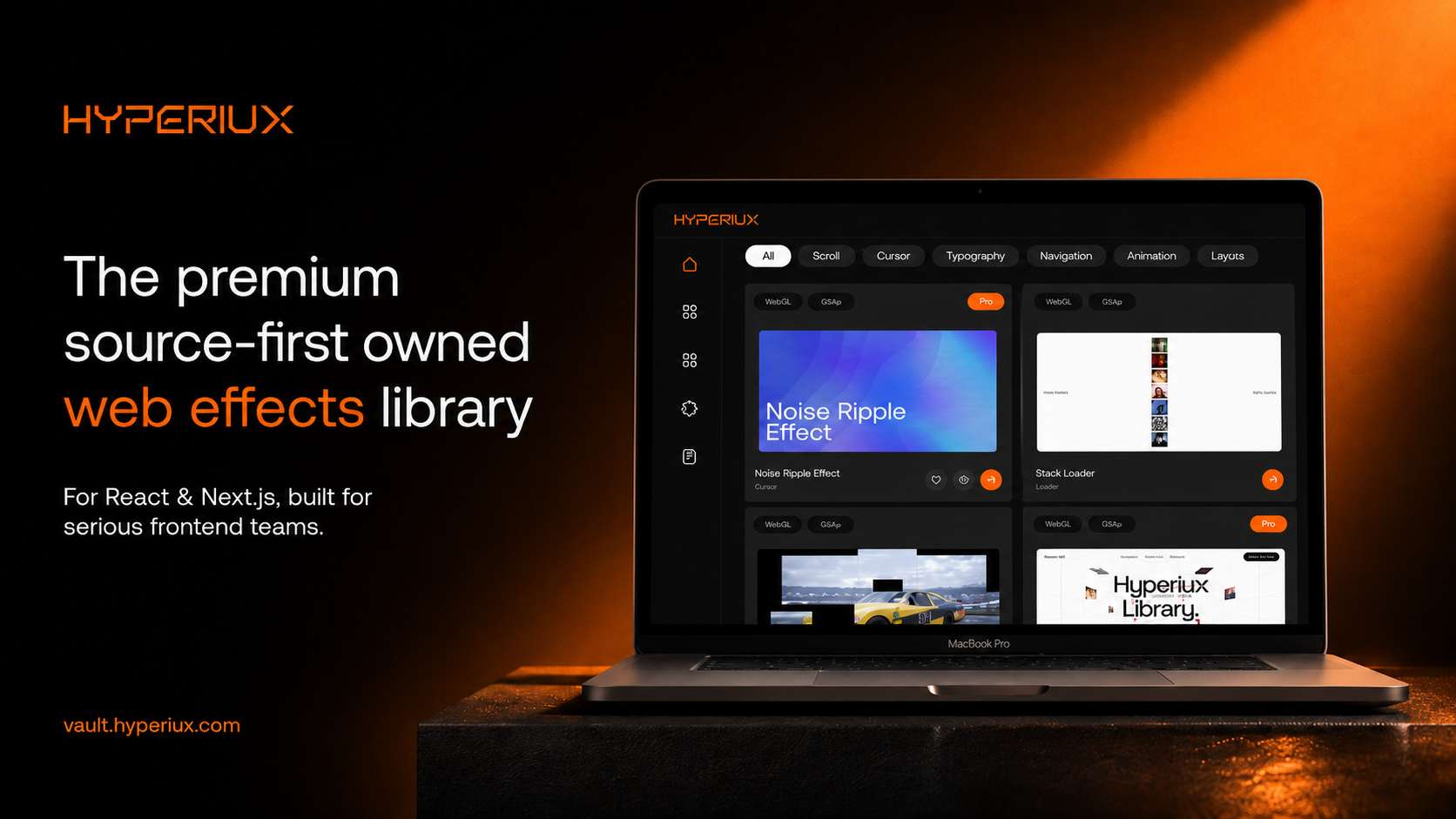
New Delhi, India – 9th July, 2026 Hyperiux Vault Brings shadcn-Style Ownership to Motion Design. Built for developers who need more than beautiful demos, Hyperiux Vault gives developers and agencies 115 scroll, cursor, text, transition, loader, background, and WebGL effects that install as editable source code via CLI or direct copy-paste, addressing a growing need for production-ready interaction patterns as advanced animation tools become more widely accessible.
Every developer who has shipped a striking animation demo knows what happens next: the client asks if it works on mobile, the accessibility review flags the motion, and someone loses an afternoon reverse-engineering a dependency nobody documented. Today, Hyperiux – a conversion focused digital experience engineering agency, announced the public launch of Vault, a source-first interaction effects library created for React and Next.js developers, design engineers, and digital agencies that want premium motion without surrendering control of their codebase.
Vault launches with 115 pre-built interaction effects – scroll systems, cursor effects, text reveals, page transitions, loaders, backgrounds, and WebGL scenes, and every one of them installs two ways: through the Hyperiux CLI, or by copying the code directly from the browser. Either path delivers the same result. Not a black-box dependency. Not a hosted widget that breaks the day the vendor changes something. The actual source code, sitting inside the developer’s own project, ready to be read, changed, stripped down, or rebuilt around, exactly like any other file they own.
The web does not have an animation problem. It has a shipping problem.
Animation tools have gotten more capable and more accessible every year. GSAP, Motion, Three.js, and modern React workflows have made striking motion easier to produce than ever. The hard part for serious teams starts after the demo works. Can the effect survive a real production build? What does it depend on? How does it behave on a five-year-old Android phone with a spotty connection? What happens the instant a user’s operating system says “reduce motion”? Does it clean up after itself, or does it quietly leak memory into a single-page app that never fully unmounts? These are not edge cases. For a team shipping client or product work, they are the actual job.
Vault was built for those questions. It isn’t trying to replace the animation engines developers already trust. It packages the production judgment around them: the source code, the dependencies, the implementation notes, the mobile behavior, the accessibility considerations, and the performance guidance that separate a striking preview from a shipped interaction.
“The web doesn’t lack animation tools anymore,” said Bhaskar, Founder of Hyperiux. “GSAP is free. Motion is free. Three.js is free. React Bits, Aceternity, and Motion Primitives are all genuinely good at what they do. Nobody building with React is short on effects right now. What’s short is confidence & knowing exactly what you’re installing, what it costs you on a slow phone, and whether you’re allowed to hand it to a client without a second look. Vault doesn’t compete on how many effects it has. It competes on whether you’d trust the effect enough to actually ship it.”
Start free. Own the code. Upgrade when the work demands more.
Vault is built so the first step costs nothing and takes minutes, not a meeting. Developers can browse the catalogue, preview effects live in the browser, and install any Free Core effect immediately; no account, no credit card, no waiting. The code lands inside the project, not behind a remote dependency, from the very first install.
That free workflow is the front door to Vault Pro. Once a team sees how a source-first effect actually behaves inside a real React or Next.js project, Pro unlocks the full premium library for more ambitious builds – portfolio launches, product sites, campaign pages, and agency client work.
For agencies, the value is speed with control. For product teams, it is polish without technical debt. For independent developers, it is the ability to deliver high-end interaction work without rebuilding the same patterns from zero on every single project.
Fast facts
- 115 creative components: 32 Free Core effects and 83 Pro effects.
- Two install paths, every effect, free and Pro alike: the Hyperiux CLI (npx hyperiux init, npx hyperiux add <effect>) or direct copy-paste from the browser — both place real, editable source code inside the developer’s own project
- Free Core is live now at vault.hyperiux.com — previewable and installable with no account required
- Built for React and Next.js, including explicit guidance for App Router client-component boundaries and browser-heavy interaction patterns
- Every Pro effect ships with dependency notes, reduced-motion guidance, mobile behavior, and performance considerations documented before install; Pro access is authenticated for active subscribers
- Pricing: Free ($0), Pro Monthly ($20), Pro Annual ($179), and a limited Founding Annual rate of $149/year for the first 100 subscribers
- Agency and team licensing available for studios using Vault across client projects
- Roadmap: 100+ free effects and 250+ total effects targeted within 12 months of launch, plus full page sections and templates, shaped directly by developer requests
- Free-tier source available now on the public GitHub repository
An interaction layer for the source-first era
Vault is positioned alongside source-first component systems such as shadcn/ui, not against them. Component libraries define the static building blocks of an interface: buttons, forms, cards, layout primitives. Vault occupies the next layer how a page moves, responds to scroll, reacts to cursor input, reveals content, and transitions between states. That is the difference between an interface that functions and one that gets remembered.
The distinction matters more as teams move away from opaque front-end dependencies and toward tools that give them code they can actually own. Vault treats interaction design as part of the codebase, not as a decorative layer bolted on at the end.
“When advanced animation engines become this accessible, the advantage stops being ‘I know this effect is possible,'” Hitesh Bhardwaj, Lead Front-End Developer at Hyperiux said. “Everyone knows it’s possible. The advantage becomes taste, documentation, and the implementation discipline to ship it cleanly. That is the gap Vault exists to close.”
How Hyperiux Vault works
A developer browses the catalogue, previews an effect live, and installs it either with a single CLI command or by copying the code straight from the page. Both paths place the effect’s full source, its styling, its animation logic, and its configuration directly inside the project. From there, it behaves like any other file in the repository: it can be edited, simplified, themed, or extended, because it is one.
Every effect is documented with the context a production team actually needs before committing to it: npm dependencies, mobile behavior, prefers-reduced-motion handling, client-component requirements, and known performance considerations. Hyperiux describes this as the difference between downloading an impressive snippet and adopting an interaction pattern a team can confidently build a business around.
A library that grows with the people who use it
Hyperiux has committed to a public roadmap: more than 100 free effects and more than 250 total effects within Vault’s first 12 months, alongside complete pre-built page sections and templates beyond individual effects, only available to Pro members. The company is opening a direct channel for developers to request specific interactions and components for the roadmap, which means the library a developer joins today is not the library they will have a year from now.
“Every Pro subscription is a bet on where this library is going, not just what’s in it right now,” Bhaskar said. “We’re not shipping a fixed catalogue and calling it finished. If a team tells us they need a specific scroll interaction, or a full landing-page section we haven’t built yet, that request can become part of the roadmap. Subscribers get everything we ship next as part of the plan they already have. No separate purchase, no upsell. The earlier someone joins, the more of that growth they get for free.”
Availability
Vault’s Free Core tier is available now at vault.hyperiux.com and includes 32 effects that require no account to preview or install. Browse an effect, copy the code or run the CLI command, and have it running in a real project before lunch.
Vault Pro, unlocking the remaining 83 premium effects, opens next week through Founding Access. The first 100 subscribers lock-in at $149 per year before standard pricing of $20 per month or $179 (discounted) per year applies.
Developers can start with the free effects today, install them into a React or Next.js project, and upgrade to Pro when they need the full premium catalog for client, product, or launch work.
About Hyperiux
Hyperiux is a digital experience design agency that helps teams solve complex design challenges through user research, expert analysis, prototyping, and collaborative design with users and stakeholders. Through Vault, Hyperiux extends that experience-design practice into a source-first interaction library built for React and Next.js teams worldwide.
Media Contact
Jyoti Pathak
Product Manager, Hyperiux
hello@hyperiux.com
+91 8178026136
https://vault.hyperiux.com
https://hyperiux.com
